

A higher VA disability rating can change a Veteran’s monthly compensation.
Sometimes, however, the most important part of a decision is not the percentage. It is having a serious condition formally recognized as service connected.
That recognition may become important later if the condition causes or contributes to the Veteran’s death and an eligible family member applies for VA Dependency and Indemnity Compensation.
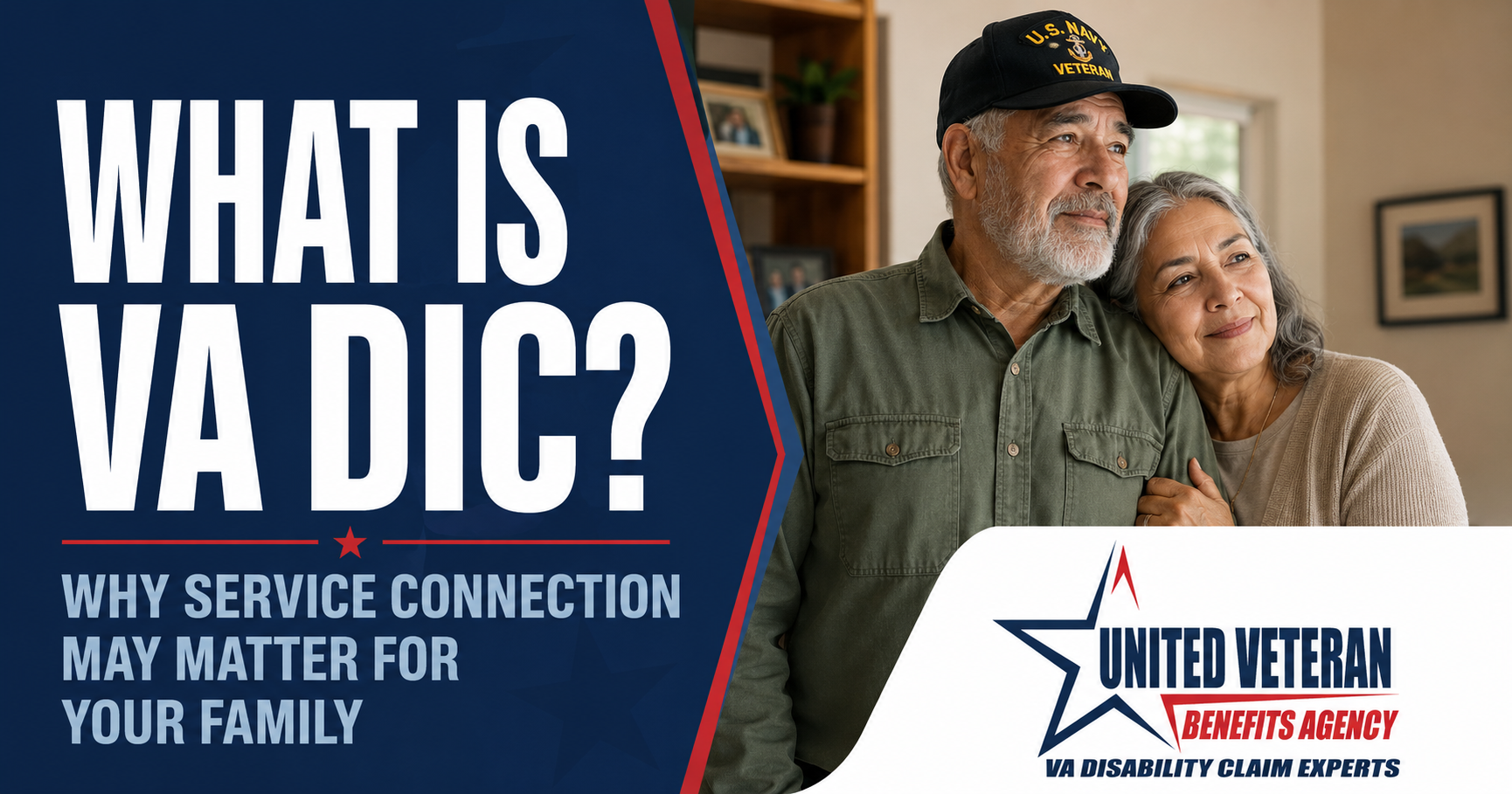
Commonly called VA DIC, this survivor benefit is often misunderstood—and it is never automatic.
VA Dependency and Indemnity Compensation is a tax-free monthly benefit that may be available to certain survivors of a service member or Veteran.
Depending on the circumstances, eligible applicants may include:
The relationship requirements differ for spouses, children, and parents. Meeting one requirement does not automatically establish eligibility for the entire benefit.
The VA reviews the survivor’s relationship to the Veteran, the circumstances of the Veteran’s death, the Veteran’s service and disability history, and the supporting evidence.
There are several potential paths to DIC eligibility.
A surviving family member may qualify if the service member died while on active duty, active duty for training, or—in certain circumstances—inactive-duty training.
Different evidence and application procedures may apply to an in-service death.
DIC may be available when the evidence shows that a service-connected illness or injury caused or contributed to the Veteran’s death.
This is where understanding what “service connected” means becomes especially important.
A service-connected condition is one the VA has determined was caused or aggravated by military service. Service connection and a medical diagnosis are not the same thing, as explained in our guide to the difference between a diagnosis and service connection.
If the Veteran’s cause of death is connected to an already service-connected condition, that disability history may become important evidence in the survivor’s DIC claim.
In certain situations, a survivor may qualify even when the Veteran did not die from a service-connected condition.
According to the VA, this path may apply if the Veteran was eligible to receive compensation for a service-connected disability rated as totally disabling:
The VA’s DIC guidance includes total disability based on individual unemployability when evaluating some totally disabling rating requirements.
These rules are specific. A 100% rating or permanent and total status does not make DIC automatic, and survivors should review the complete eligibility requirements that apply to their circumstances.
A VA disability rating answers two different questions:
The assigned percentage affects current compensation. Service connection establishes the VA’s recognition that the condition is related to service.
That distinction can matter if the condition later causes or contributes to the Veteran’s death.
For example, if a Veteran has a serious heart condition recognized as service connected, the surviving family may have an established history showing that the VA connected that condition to military service. If the heart condition later causes or contributes to the Veteran’s death, that history may become relevant to a DIC application.
It still does not guarantee approval. The survivor must apply, meet the relationship requirements, and provide the evidence requested by the VA.
This is one reason Veterans should read their decisions carefully rather than focusing only on the combined percentage. Our guide to confusing VA decision-letter terms can help explain what the VA actually decided.
Not necessarily.
A survivor may still apply for DIC when the condition that caused the Veteran’s death was not formally service connected during the Veteran’s lifetime.
In that situation, the VA will evaluate whether the available evidence establishes that the cause of death was connected to military service.
That may require military records, medical evidence, the death certificate, and other documentation showing the relationship between the Veteran’s service, health condition, and death.
A prior service-connection decision can provide an established record, but its absence does not always prevent a survivor from applying.
The required evidence depends on the survivor and the basis of the application. It may include:
The VA provides a current summary of the evidence needed for DIC and other survivor claims.
A condition appearing on the death certificate may be important, but the VA reviews the complete record. The precise wording of medical evidence and the relationship between the cause of death and the Veteran’s service-connected conditions can affect the decision.
The correct application depends on the survivor’s relationship to the deceased service member or Veteran.
Applications may be submitted through the VA’s available methods, including QuickSubmit, mail, or delivery to a VA regional office. Survivors may also seek help from a VA-accredited VSO representative, attorney, or claims agent.
The VA provides current application instructions on its official DIC eligibility page.
Survivors should not assume there is no reason to apply because time has passed. However, the filing date can affect when benefits begin.
If the VA receives a DIC claim within one year of a Veteran’s death after service, the effective date may be the first day of the month in which the Veteran died.
If the claim is received more than one year after the Veteran’s death, the effective date is generally the date the VA receives the claim.
The VA explains these rules on its disability compensation effective-date page.
A survivor who believes they may qualify should review the current requirements promptly rather than relying on assumptions about deadlines or retroactive payments.
Changes in law may create new possibilities for some survivors.
For example, the PACT Act expanded presumptive conditions and qualifying toxic-exposure circumstances. A survivor whose previous DIC claim involved a condition that is now presumptive may be able to submit a new application or request reevaluation.
The VA specifically encourages survivors who believe they may now qualify under the PACT Act to apply rather than waiting for the VA to contact them.
A prior denial does not automatically mean a survivor qualifies now. It means the current law, evidence, and reason for the earlier denial should be reviewed.
DIC and VA Survivors Pension are separate benefits.
DIC is generally connected to:
Survivors Pension is generally a needs-based benefit for certain surviving spouses and unmarried dependent children of deceased Veterans with qualifying wartime service.
A survivor may encounter both benefits on the same application, but the eligibility rules are different. The VA determines which benefit or benefits may apply.
Veterans understandably focus on the immediate effects of a VA decision:
Those questions matter.
But a service-connection decision may also become part of a much longer story—one that could affect health care, additional benefits, and potentially a surviving family member’s DIC application.
That is why understanding the decision matters just as much as seeing the percentage. Veterans can also explore our guide to the most overlooked benefits after receiving a VA disability rating.
If you have questions about what service connection means or want to understand UVBA’s educational and consulting services, start a conversation with our team.
For assistance filing a DIC application or formal representation before the VA, survivors should use the VA’s directory to locate an accredited VSO representative, attorney, or claims agent.
Sources:
Disclaimer: This article is for general educational purposes and is not legal advice. UVBA is not affiliated with, recognized by, or accredited by the Department of Veterans Affairs. DIC eligibility and effective dates depend on the survivor’s relationship, the Veteran’s service and disability history, the circumstances of death, the evidence, and the laws in effect when the VA reviews the application.