
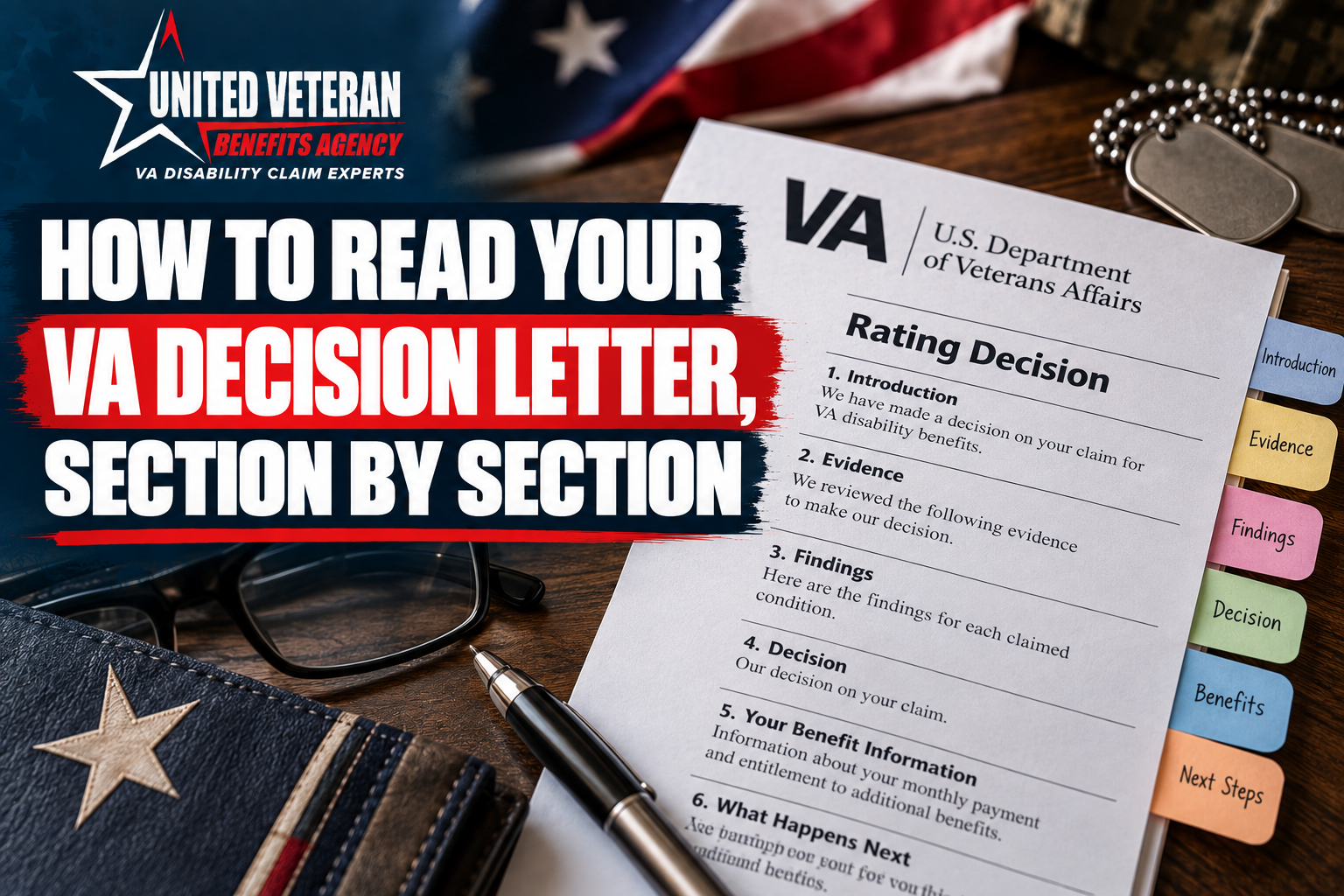


A VA decision letter can feel like it's written in another language. It's long, it's full of codes and formal phrasing, and the information that actually matters to you can get buried in the middle of it. Here's what to actually look for, and in what order.
Somewhere near the top, the letter will state the outcome for each condition you claimed: granted, denied, or deferred (meaning VA needs more information or more time before deciding that particular condition). It's common for a single decision letter to cover multiple conditions with different outcomes for each one, so don't assume the whole letter has one single answer. Check the outcome condition by condition.
For anything granted, the letter states the percentage you've been rated at, and the effective date, which is the date VA considers your payments to start from. These two numbers matter more than almost anything else in the letter, since they determine both your current compensation and often your back pay, if any is owed.
This is usually the longest part of the letter, and also the most useful one if something didn't go the way you expected. This section explains the reasoning VA used, including what evidence it considered and how that evidence did or didn't support the claim. If a condition was denied or rated lower than expected, this is where you'll generally find out why, which is also exactly what you'd need to address in a future claim or review.
Decision letters lean on abbreviations and shorthand that don't mean much if nobody's explained them. "SC" means service-connected. "NSC" means not service-connected. A diagnostic code is just VA's internal reference number for a specific condition, not something you need to memorize. None of these are meant to be confusing on purpose, but they read that way the first time you see them, and it's worth not letting unfamiliar shorthand make the letter seem harder to understand than it actually is.
Most VA decisions give you about one year from the date on the letter to request a review through a Higher-Level Review or a Board Appeal, though some benefit types carry shorter windows, so it's worth confirming the specific deadline stated in your own letter rather than assuming the general rule applies exactly as written. A Supplemental Claim works a little differently: you can generally file one at any time, but filing within that same roughly one-year window is what typically protects your original effective date. Either way, your letter is the authoritative source for your specific deadline, so it's worth holding onto rather than setting aside once you've read the outcome.
If the decision went the way you hoped, keep your copy somewhere safe. If it didn't, or if part of it is confusing, take a little time before deciding how to respond. A Supplemental Claim, a Higher-Level Review, and a Board Appeal each work differently and fit different situations, and picking the right one often matters more than picking quickly. If you're not sure what the letter is actually telling you, that's a reasonable thing to ask someone to help you read before you decide what to do about it.
If you're earlier in the process and haven't filed a claim yet, submitting an Intent to File first can protect your effective date while you gather what you need. And since the strength of any decision traces back to what was actually in your file, our post on why medical records matter more than you think is worth a look too.
We're not VA accredited, and we don't file or represent claims before the VA. What we do is sit down with a Veteran's actual decision letter and explain it in plain English, not VA-speak, so you know exactly where you stand before deciding what happens next. If you've ever wondered what the difference is between what we do and what an accredited representative does, our accreditation explainer covers that directly.
Every case is different, and reading your letter with us doesn't guarantee a particular next step will work out a certain way. But it does mean you're deciding what to do next from a clear understanding of what the letter actually says, not just the parts that are easy to read quickly.
👉 Have our team walk through your decision letter with you