
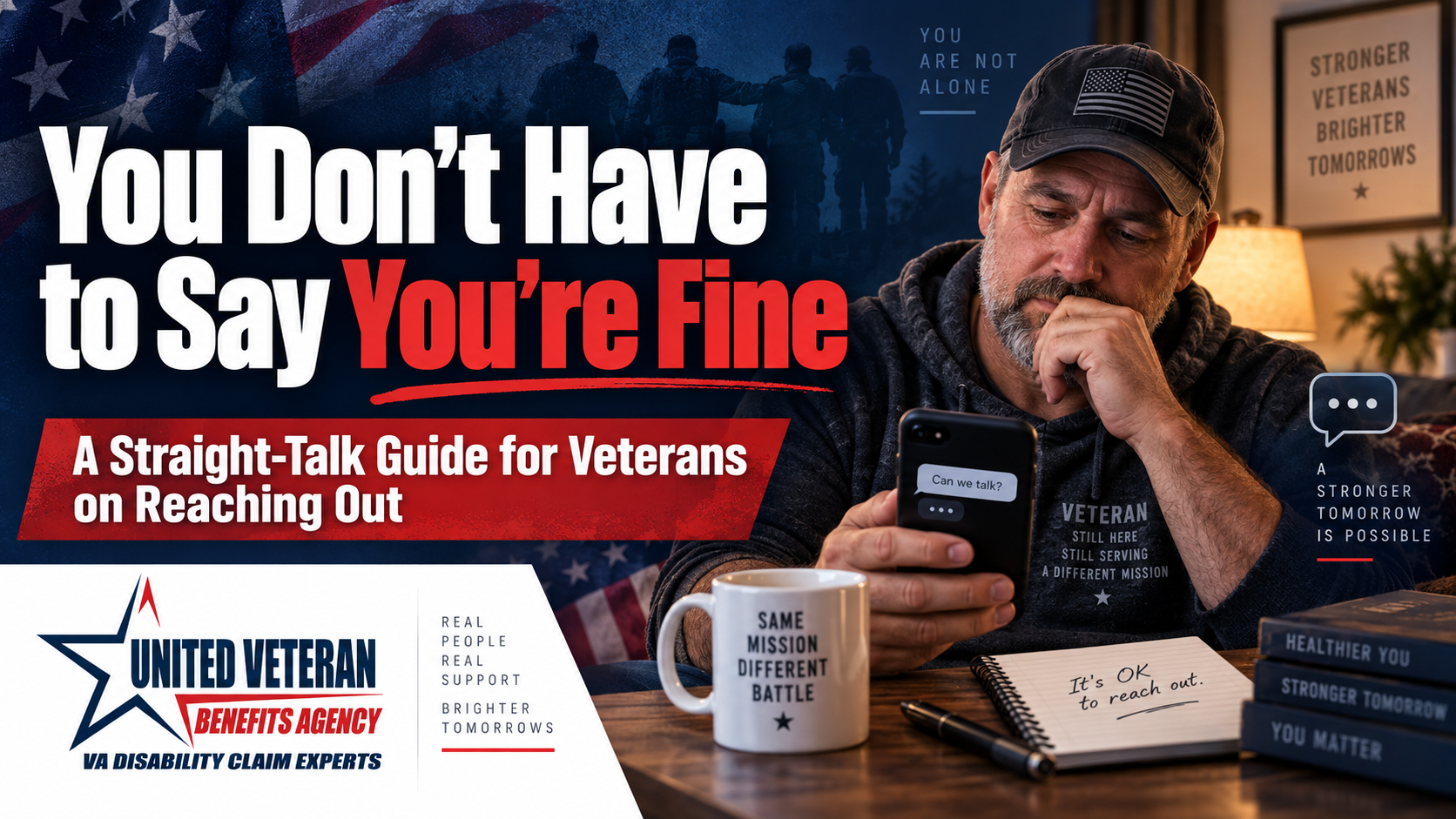


"I'm fine." It's probably the most automatic sentence in the military vocabulary. Someone asks how you're doing, and it comes out before you've even thought about whether it's true.
This week is National Suicide Prevention Week. We're not going to give you a clinical rundown of warning signs and statistics. We just want to talk plainly about that reflex, where it comes from, and why it can work against you now in a way it never did in uniform.
In the military, saying you were fine wasn't dishonesty. It was often the job. Mission first, complaints later, don't be the reason the team slows down. That instinct kept people moving through things that genuinely needed to get done.
The problem is that instinct doesn't come with an off switch when you take the uniform off. A lot of Veterans carry it straight into civilian life, still pushing through old injuries, bad nights, and things nobody else can see, because that's just what you do. It made sense then. It can be dangerous now, especially when there's no mission left that requires it.
If you're pushing through pain, old trauma, or a stretch that's been harder than you've let on, you're not alone in that, even if it feels that way. This is common enough among Veterans that it has a name in the research: functioning while struggling, showing up, doing the job, keeping it together on the outside, while something real is going on underneath.
None of that makes you weak. It makes you human, and it makes you someone who could probably use one honest conversation more than another "I'm fine."
You don't need a checklist to know when something's off. But a few things are worth paying attention to, in yourself or in a battle buddy: pulling away from people you used to talk to, sleep that's been off for weeks instead of days, talking about being a burden to people, or a kind of calm that shows up suddenly after a long hard stretch. None of these mean something is definitely wrong. But they're worth a direct conversation instead of a wait-and-see.
The VA built its suicide prevention message around one simple idea: #BeThere. Not fix it, not have the perfect words, just show up. Ask a real question and actually wait for the answer. Sit with someone instead of trying to talk them out of how they feel. Most people don't need a solution in the moment. They need to know someone actually noticed.
If you're the one struggling, the same idea works in reverse. You don't need the right words either. You just need to reach out before you're sure you're ready to.
Maybe none of this is about you right now. Maybe it's your battle buddy who's gone quiet, or your spouse who's been "fine" a few too many times in a row. You don't need permission to bring it up, and you don't need to be a counselor to ask a real question.
Something as plain as "you haven't seemed like yourself lately, what's going on" opens more doors than people expect. You don't have to fix whatever they tell you. You just have to actually hear it, and let them know you're not going anywhere.
This is free, confidential, and available whether or not you're enrolled in VA health care.
A real, trained responder answers, not a machine. You decide how much you want to share. This is for you if you're struggling, and it's also for you if you're worried about someone else and don't know what to do next.
If it's your friend, your spouse, your battle buddy you're worried about, you don't have to have the right words either. You just have to be the one who asks the real question, and actually waits for the answer. You might end up being the reason they make the call.